




The mind-bending that never ends
The mind-bending that never ends
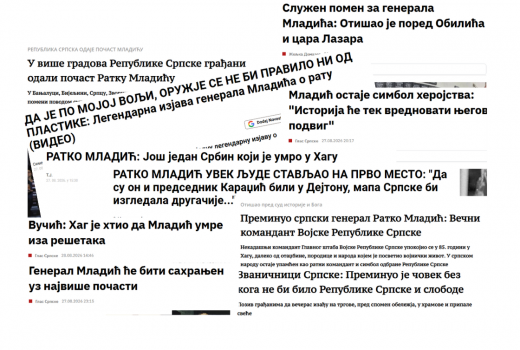
After Mladić's death, the public space was flooded with denial of crimes, belittling of victims and glorification of criminals.
photo: Canva
I first heard about Ratko Mladić at the end of May 1992, when I was nine years old. The war in Bosnia and Herzegovina had already been going on for a long time. We replaced the apartment with a shelter, mistreatment of Sarajevo civilians became part of everyday life, and life was increasingly being reduced to waiting, fear, panic, uncertainty and shooting.
At that time, we still had electricity, so I heard Mladić's order on television to "hit Velušići". After his interlocutor Mirko Vukašinović corrected him that it was Velešići, he gave his famous order that has been deeply etched in my memory: "Hit Velušići and hit Pofalići, there are not many Serbs there". He ordered that the Presidency and the Parliament be kept under direct fire and that the areas around Dobrovoljačka, Humska and Đure Đakovića streets be "hit", with the demand that they be shelled so much that people could not sleep and that "their minds be bent".
The mind-bending continued for the next three and a half years. Sarajevans were subjected to systematic terror – we were denied food, electricity and water, the city was kept under siege for years, and life was reduced to survival. People ate food from humanitarian aid that even dogs wouldn't eat. Mladić's soldiers shot people like clay pigeons – sniping at children and adults, and shooting and targeting people standing in lines for bread and water.
The mind-bending has not stopped even almost 31 years after the end of the war. Nor will Mladić's death change anything. What he and his soldiers left behind are mass graves, dead and butchered people, ruins, ethnically cleansed territories and mass support. Instead of murals and plaques in the Republika Srpska entity, we will now see his monuments. He will be buried with full military honors in Serbia.
The passage of time will certainly contribute to him being given numerous characteristics that he had not possessed in the slightest, because that is how it is with myths and legends. Ideology does not disappear with the death of anyone, it usually strengthens even further, inscribing mythical characteristics in ideologists. We are witnessing exactly this these days.
'He defended the Serbs from the new Jasenovac'
If we are to believe the famed “experts” who are attacking us from all sides these days – from the media in Republika Srpska and Serbia, not to mention social media networks, that cesspool of uncensored opinion, the people of Sarajevo have actually done all this to themselves. I will deal with this disgusting relativization, denial and rewriting of facts in the rest of the text. For this is no longer just about different interpretations of the past, whatever that worn-out term means, but rather an attempt to obscure the responsibility of the perpetrators, to question the victims, and to declare thoroughly documented facts a conspiracy and replace them with more suitable versions of events, and to declare the crime a heroic defence. This is a serious form of historical revisionism and normalization of crime. But this is nothing new, nor did it happen with the death of Ratko Mladić.
One only needs to look at the media content that comes from the mentioned areas every July 11 or one of the dates commemorating war sufferings, such as, the beginning of the siege of Sarajevo, the anniversary of one of the numerous massacres. Or let's say the annual celebration on January 9.
It is safe to say that this reaction was expected, but one cannot help but remain speechless before the "interpretations" coming from the mouths of numerous public figures, who take turns like clockwork, not to mention the opinions of influencers and other "employees" of social networks.
For example, Sarajevo-born Ljiljana Smajlović, former editor of the Oslobođenje daily, explains in her commentary on Euronews Serbia that Serbian history will remember Mladić as a general who defended the Serbs who remained in the former Yugoslavia to live in the territories where he defended them. "Neither the Hague verdicts nor the hatred of our neighbors in the region will be able to do anything against such a fact, which is a fact. Ratko Mladić is the commander under whom they survived, or, as the myth will say, in folk tales, in my opinion, the folk tales will say that Jasenovac was not repeated and genocide against Serbs was not repeated because of Ratko Mladić."
This thesis has been present in the public space for a long time, especially on social media networks. According to this interpretation, ethnic cleansing is "defence", the actions of military and paramilitary formations that cleansed eastern Bosnia and numerous other parts in the first months of the war in 1992 are defence of the home, and that the home is "defended" by paramilitary formations composed of soldiers who have nothing to do with BiH. All of this, as well as the mind-bending of Sarajevo residents, to use the thesis of the aforementioned editor, is nothing more than defence against a new genocide. It’s enough to make you wonder if you’re losing your mind.
The crimes in Prijedor were also "defence". We can also hear that thesis served to us by smiling "interpreters of the past" in the comments of ordinary people that we have the opportunity to watch on various TV stations with announcements that we will now hear what the citizens think about Mladić's death.
He definitely knew what he was doing
Ratko Mladić was already a well-known name at the time of the order we mentioned at the beginning of the text. Without dwelling on his biographical data, especially since hundreds of such texts have been published so far, I will remind you that he was a professional Yugoslav National Army (JNA) officer, that he graduated from the Military Academy in Belgrade as the best in his class, with an average grade of 9.57. He spent his entire professional life in the army, advancing through command positions in Skopje, Ohrid, Kumanovo and Pristina. During the war in Croatia, he was in Knin. Therefore, he did not enter that war as an inexperienced soldier, but as an already formed and highly ranked officer of the Yugoslav army.
His war journey did not begin in Bosnia and Herzegovina. As commander of the 9th Knin Corps of the JNA, he participated in the war in Croatia in 1991. The Šibenik County Court sentenced him in absentia to 20 years in prison. His crimes in Croatia, however, were not included in the Hague indictment, not because they were unimportant, but because the Prosecution focused on the most serious crimes for which it had the strongest evidence.
I would like to remind the readers of another statement of his. On May 12, 1992, Mladić made it very clear that he understood the nature of what was being prepared. Speaking about the plan for the ethnic separation of the population, he said: "We cannot clear, nor do we have a sieve to sift [people] only so that the Serbs remain or the Serbs to remain and the rest leave [...] I don't know how Mr. Krajišnik and Mr. Karadžić will explain this to the world. This, people, is genocide."
He knew very well what he was doing and he knew the nature of the violence he was carrying out. This is perhaps best demonstrated by what he said in front of the cameras in Srebrenica on July 11, 1995. After the city fell, he presented the victory of his forces as a “gift” to the Serb people, saying that the time had finally come, after the historic rebellion against the Dayi (Ottoman military officers), to “take revenge on the Turks in this region.”
Crime documentation
The post-war years were marked by his hiding in Serbia, just as many others are still hiding there. According to data from non-governmental organisations, there are at least 67 of them. His hiding ended in 2011 following his arrest almost 16 years after the Srebrenica genocide. The “objective” interpreters of the past will spend decades explaining that nothing happened there. Then they will claim that a crime did happen, but that legal qualifications and numbers are inaccurate, only to arrive to the claim that Mladic was a humanitarian who saved women and children and that the killed men were actually soldiers.
At the time the proceedings began, the indictment against him had 11 counts, the trial lasted almost five and a half years. He was sentenced to life imprisonment for genocide in Srebrenica, persecution, extermination, murder, deportation and forcible transfer, terrorizing the population of Sarajevo, unlawful attacks on civilians and taking UN personnel hostage. The Appeals Chamber confirmed the verdict and life sentence in June 2021.
None of this is enough for his followers, because there is another claim - the Hague Tribunal tried only Serbs, it is a NATO court (although these same followers ardently support the Israeli genocide against the Palestinians, never mind that it is one of the most powerful NATO allies), the witnesses are false, he was imprisoned innocent, and even the latest claims appeared that he was poisoned and killed in prison.
The volume of evidence is best illustrated by the statistics of the process itself. The trial lasted almost five and a half years, of which 530 days were spent in hearings, 377 witnesses testified before the Trial Chamber, while a total of 592 were called to testify, and 9,914 exhibits were included in the file. The Chamber also took into account around 2,000 facts that had already been established by final judgment from other proceedings. The evidentiary proceedings lasted more than four years, and the closing arguments were held in December 2016. The first-instance verdict from 2017 had 2,526 pages, while the final, appeal verdict from 2021 had more than 1,304 pages. Anyone who doubts the objectivity of the court, the witness statements, and the evidence can read all these documents for themselves, when they take time away from praising Mladić on social media, and they can make their own judgment.
Reactions from the Federation of BiH
These days, politicians and other public figures from the Federation of BiH entity are calling on citizens to report to the Prosecutor's Office of BiH all those who deny genocide and glorify war criminals. If a person were to really take up this job, they could sit for days and file reports, because so much denial, belittling of victims and glorifying of criminals is present in the public space. After all, it is quite clear that it is impossible to process such a number of cases, even if there were a political will to do so. And we have long been convinced that the Prosecutor's Office of BiH is anything but a professional and politically independent institution headed by professionals. There is much evidence for this, much stronger than those that tell us that The Hague was created to convict "Serb heroes". In this regard, it is difficult to expect that it will be the place where this story will end seriously and consistently. And we should have no illusions about this.
The media these days is flooded with content about Mladić, much of which boils down to the banal transmission of what this or that influencer said, as if every post on social media represents a relevant contribution to understanding war and crime. In this chaos, a much more serious, but equally banal relativization is also creeping in, which is carefully packaged in a seemingly fair message that “everyone should be held accountable” - because no, not everyone can be held accountable in the same way, nor can the sentences be the same. A man who has been finally convicted of genocide, persecution, murder, terrorizing civilians and other serious war crimes cannot be put on the same level as someone who is responsible for, say, not prosecuting criminals, for remaining silent, relativizing or politically obstructing the confrontation with crimes. These are not the same types of responsibility, nor can they be reduced to the same moral and legal measure, as “lovers of justice” are telling us these days. If we are going to equate them, then we no longer need the courts. We can immediately introduce one universal punishment for everyone, so that everyone gets it, regardless of what they have done. Thus, in the name of alleged equality and reconciliation, we would actually abolish the very idea of individual responsibility and the gravity of the crime committed.
Mladić's death will not bring back the dead nor will it bring peace to the survivors. However, it is important that he did not die at large, but as a finally convicted war criminal, after a verdict in which his crimes were extensively documented. All of today's relativizations cannot change that fact. No matter how hard the relativizers try.
Perhaps it is finally time to admit that the numerous NGO workshops of various international organizations on dealing with the past, reconciliation and building trust, in which facts were greatly relativised and tendentiously selected, did not achieve what they were supposedly intended to achieve. In fact, paradoxically, they often only further strengthened nationalist narratives. How much of this is a consequence of their methods, and how much of the real intentions of those who organized them, is a topic for another long article.

The content of the article is the sole responsibility of the project implementers and does not necessarily reflect the views of the European Union, the Norwegian Ministry of Foreign Affairs (NMFA), Centar za promociju civilnog društva (CPCD), Center for Research and Policy Making (CRPM) or Institute for Democracy and Mediation (IDM).